The Birth of Branch #1111: How Las Vegas Built Its First Civil Rights Movement
Honoring the founding of the NAACP Las Vegas Branch — February 14, 1928
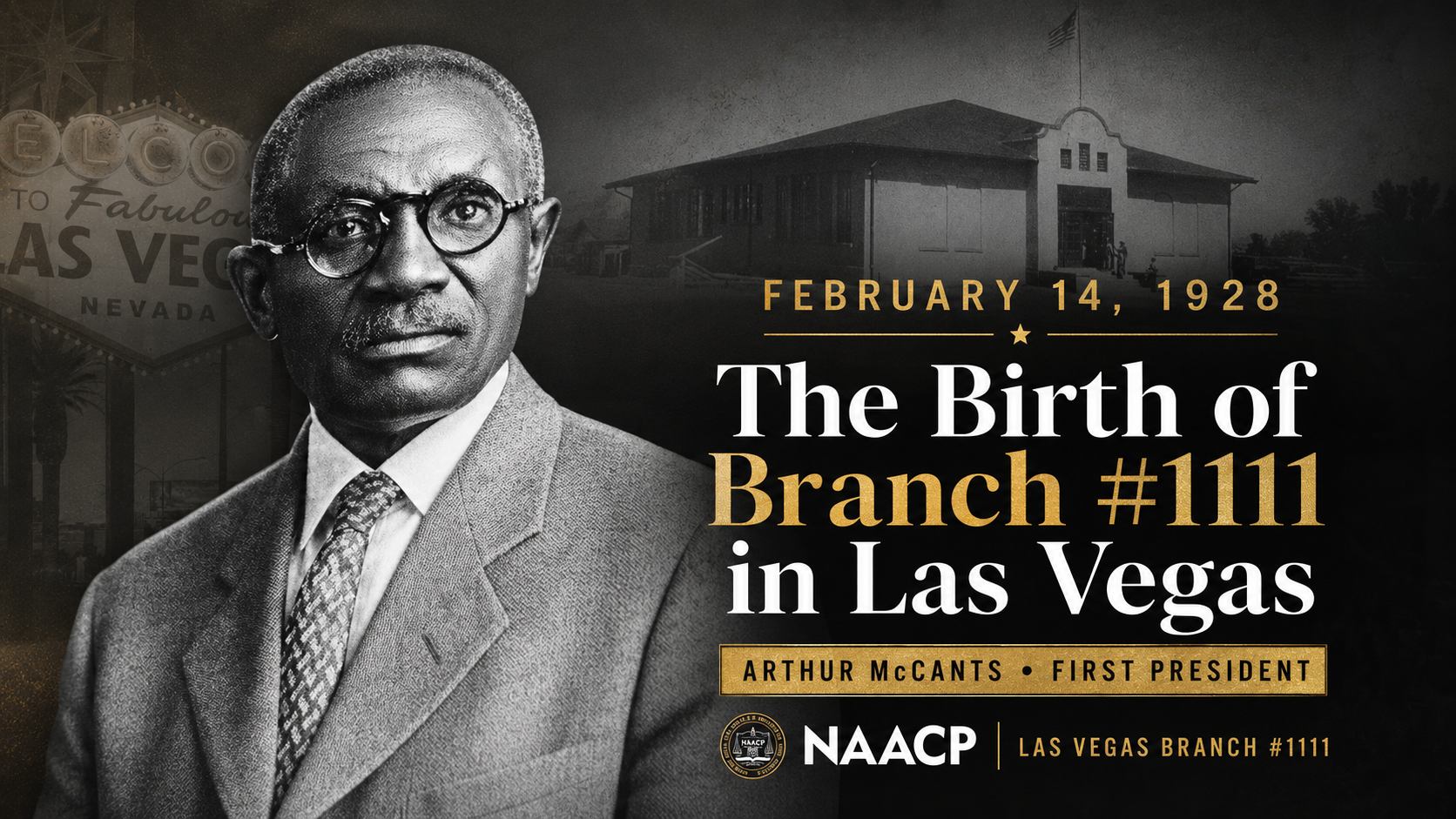
Arthur McCants Became Branch 1111 Frist Branch President on February 14, 1928
On February 14, 1928, five Black residents of a dusty railroad town in the Mojave Desert did something quietly radical. They chartered the Las Vegas Branch of the National Association for the Advancement of Colored People — the organization we know today as Branch #1111. Arthur McCants, Mary Nettles, Zimmie Turner, William "Bill" Jones, and Clarence Ray put their names to a movement at a moment when doing so carried real risk. To understand why that act mattered so much, you have to understand the Las Vegas they were living in.
A Town Divided by the Tracks
Las Vegas was barely two decades old in 1928, and segregation was written into its very geography. The city was born from a rivalry between two settlements sitting literally on opposite sides of the railroad tracks. The surveyor J.T. McWilliams had laid out a townsite west of the tracks, but when the San Pedro, Los Angeles & Salt Lake Railroad held its land auction in 1905, it held the decisive advantage — it controlled the water. Residents who could afford to picked up and moved east of the tracks to the railroad's new town, some literally hauling their houses with them on skids. Those who couldn't were left behind on the west side, where dirt streets ran past tents, shanties, and outhouses.
In these early years, life for Black Las Vegans was not yet defined by the hardened, codified segregation that would come later. Many of the city's earliest Black residents worked in the railroad shops, and the railroad encouraged its employees to buy property — so a number of Black families owned their own homes, and some owned several. Mary Nettles, one of the future branch founders, owned multiple parcels in the area known as Block 17, took in washing, ran boarding houses, and served as a spokesperson for the Black community in town meetings. Hers was a story of real ownership and standing in a young, still-forming town.
But the ground was already shifting beneath that community. Through the 1920s, Black residents faced mounting pressure to leave the downtown area east of the tracks. City officials wielded business licenses as a weapon, threatening not to renew them for Black-owned establishments unless they relocated. The squeeze that would eventually concentrate the entire Black community into West Las Vegas — the Historic Westside — was already tightening.
The Klan on Fremont Street
If anyone needed a reminder of the danger in the air, they got one in 1925, when the Ku Klux Klan marched down Fremont Street in full regalia. This was not the Deep South; this was the main street of a Nevada boomtown. The march was a public, deliberate display of intimidation — a signal to Black residents about who the marchers believed the growing town belonged to.
That display landed in a community that was watching the national winds change. Las Vegas in the 1920s had no formal Jim Crow laws on its books, but the influx of newcomers — many of them white Southerners chasing the promise of the desert's next big thing — was importing Southern racial attitudes into a place that had once been more fluid. The pioneer-era Nevada with no firm color line was disappearing, and the people who would found the NAACP branch could see it going.
The Dam on the Horizon
Looming over everything was the prospect of the largest federal construction project the region had ever seen: the dam in Black Canyon that the world would come to know as Hoover Dam.
In early 1928, the dam was still a fiercely debated proposal rather than a jobsite. Congress would not pass the Boulder Canyon Project Act until December of that year, and actual construction would not begin until 1931. But the anticipation was electric. Everyone understood that the project would draw thousands of workers and millions of dollars to Southern Nevada, and that it could remake the fortunes of anyone positioned to share in it.
For the Black community, that promise came wrapped in a warning. As the project moved toward reality, the pattern of exclusion became impossible to ignore: Black workers would be systematically shut out of jobs on the federally funded dam, and barred from living in Boulder City, the tidy new company town the government built for the workforce. The single greatest economic opportunity in the region's history was being engineered to leave Black families on the outside.
It was in this exact climate — a town tightening its segregation, a Klan that felt free to march in the open, and a historic federal project preparing to exclude them — that five people decided their community needed an organized, collective voice. The time for individual endurance was over. On February 14, 1928, they chartered the Las Vegas Branch of the NAACP.
The Five Founders
The founders were not outside agitators or imported organizers. They were the community's own pillars.
Arthur McCants, a World War I veteran and the son of a man who had been enslaved in Alabama, became the branch's first president. He would spend decades as one of the Westside's most determined advocates, lending his name and his leadership to the fight for fair employment, better housing, and basic dignity.
Mary Nettles was already a property owner, landlord, and recognized community spokesperson by the time the branch formed. She brought standing, resources, and a voice that local officials had learned to listen to.
Clarence Ray became one of the most important keepers of this history; his oral account, preserved today in UNLV's Special Collections, is one of the reasons we can still hear how the early Westside actually lived. He was central to establishing the local chapter.
Zimmie Turner and William "Bill" Jones rounded out the founding five, joining their neighbors in committing to a mission that was as much about survival as it was about civil rights.
Together they built something that did not yet exist in Las Vegas: an institution whose entire purpose was to demand that African Americans be treated as full citizens — in jobs, in housing, in public life.
Timeline Moment
NAACP Las Vegas Branch 1111 is Founded
Arthur McCants, Mary Nettles, Clarence Ray, Zimmie Turner, and Bill Jones became this branches first leadership group.
What Came After
The branch went to work immediately. When its founders learned of the discriminatory hiring practices tied to the dam project, they acted, pressing for equal employment and for better living conditions for the Black families increasingly confined to West Las Vegas. McCants, as president, would later publicly condemn racist treatment of Black workers even at facilities like the Basic Magnesium plant during the World War II era — a sign of how durable the branch's watchdog role became.
The years after the branch's founding were, in many ways, the hardest. Segregation in Las Vegas did not loosen in the 1930s and 1940s — it hardened. The legalization of gambling in 1931 brought wealthy Southern gamblers who pressured casino owners to keep Black patrons out. Black entertainers could perform on the Strip but could not stay in, or be served by, the very hotels that booked them. By 1939 the city had passed an ordinance pushing Black residents into West Las Vegas, and by the 1940s officials were forcing the relocation of the once-thriving Black community east of the tracks across to the Westside. Las Vegas would earn the bitter nickname "the Mississippi of the West."
Through all of it, Branch #1111 endured. The organization that five people founded on Valentine's Day in 1928 became the institutional backbone of the long struggle that followed — the fight that would eventually lead to the desegregation of the Strip in 1960 and to civil rights gains across Southern Nevada. Nearly a century later, the branch is still here, still advancing equality in housing, education, economic access, and voting rights.
A Birthright, Not a Privilege
The founding of NAACP Las Vegas Branch #1111 was never just a matter of paperwork and a charter number. It was an act of survival, resistance, and hope, undertaken by people who could have kept their heads down and instead chose to stand up. They built a collective voice in a town that wanted them silent, and they did it in the shadow of a Klan march and on the eve of a federal project designed to exclude them.
They organized because they believed something simple and unshakable: that civil rights are a birthright, not a privilege. That belief is the inheritance every member of Branch #1111 carries forward today.
Sources & Further Reading
NAACP Las Vegas Branch #1111 — The Birth of NAACP Las Vegas Branch #1111
Clark County Public Art — Unsung Pillars of the Westside: A Timeline of Legacy
FOX5 Las Vegas — Early African American Pioneers Pave the Way in Southern Nevada (Feb. 2026), featuring UNLV's Dr. Tyler Parry and community historian Minister Stretch Sanders
UNLV Special Collections — Clarence Ray oral history (see UNLV Special Collections & Archives digital collections) and the Mabel Hoggard Papers, NAACP materials 1946–1986
Las Vegas Advisor — How Much Racial Segregation Existed in Las Vegas's Past?
Nevada State Historic Preservation Office — African American Civil Rights Experience in Nevada: Historic Context
PBS, American Experience: Las Vegas — African Americans in Las Vegas
Las Vegas Sun — Fighting Racism (civil rights timeline)
City of Las Vegas — Historic Westside Timeline (The HUNDRED Plan)
A note on dates: Branch #1111 marks its founding as February 14, 1928. The Boulder Canyon Project Act authorizing Hoover Dam was signed in December 1928, and dam construction began in 1931 — so in February 1928 the dam was an anticipated and hotly debated prospect, and the discrimination surrounding its workforce intensified as the project advanced.
Join the Legacy
This History Was Made by Ordinary People Who Showed Up.
The work continues through members, volunteers, advocates, students, partners, and community leaders who choose to move Las Vegas forward.